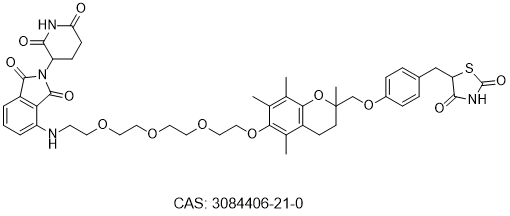
dACSL4 is a potent, selective PROTAC degrader targeting ACSL4 (DC50=103 nM, SH-SY5Y cells) by conjugating troglitazone to the CRBN-binding ligand pomalidomide, concurrently degrades ACSL4 and activates PPARγ signaling.
dACSL4 induced ACSL4 degradation through the UPS, MG-132 prohibits dACSL4-mediated ACSL4 degradation.
dACSL4 degrades ACSL4 through CRBN-mediated ubiquitination and subsequent proteasomal degradation.
dACSL4 demonstrates robust PPARγ activation, approximating 90% of the efficiency of the parent ligand, troglitazone (TRO), with an EC50 value of approximately 760 nM.
dACSL4 shows significant reduction for other ACSL isoforms, such as ACSL1, ACSL3, and ACSL5.
dACSL4 enables efficient ACSL4 degradation while preventing productive ternary complex formation with PPARγ, thereby preserving its functional activation.
dACSL4 inhibits neuronal ferroptosis, effectively inhibits both lipid peroxide (LPO) elevation and cell death in SH-SY5Y cells exposed to 100 μM of 6-OHDA.
dACSL4 exhibits dose-dependent protection against RSL3-induced neurotoxicity.
DACSL4 suppresses ferroptosis via PUFA remodeling and PPARγ-GPX4 axis activation.
Intranasal delivery of dACSL4 using biodegradable lipid nanoparticles (BAmP-TK12) enabled brain-preferred ACSL4 degradation and PPARγ activation, reducing lipid peroxidation and preserving dopaminergic neurons in a Parkinson’s disease model, ultimately improving motor function.